Prefab & Seismic Engineering: Early is Better
BackReal project gains from early structural planning of building services
Every building project has its own unique constraints, challenges, and pressures, yet they all share the same core objectives: deliver a building that complies with the NCC and project goals, on time and within budget.
Planning plays a critical role in project outcomes. The MacLeamy Curve highlights that the influence of decisions on cost, performance, and final results is greatest at the very beginning of a project, long before construction starts.
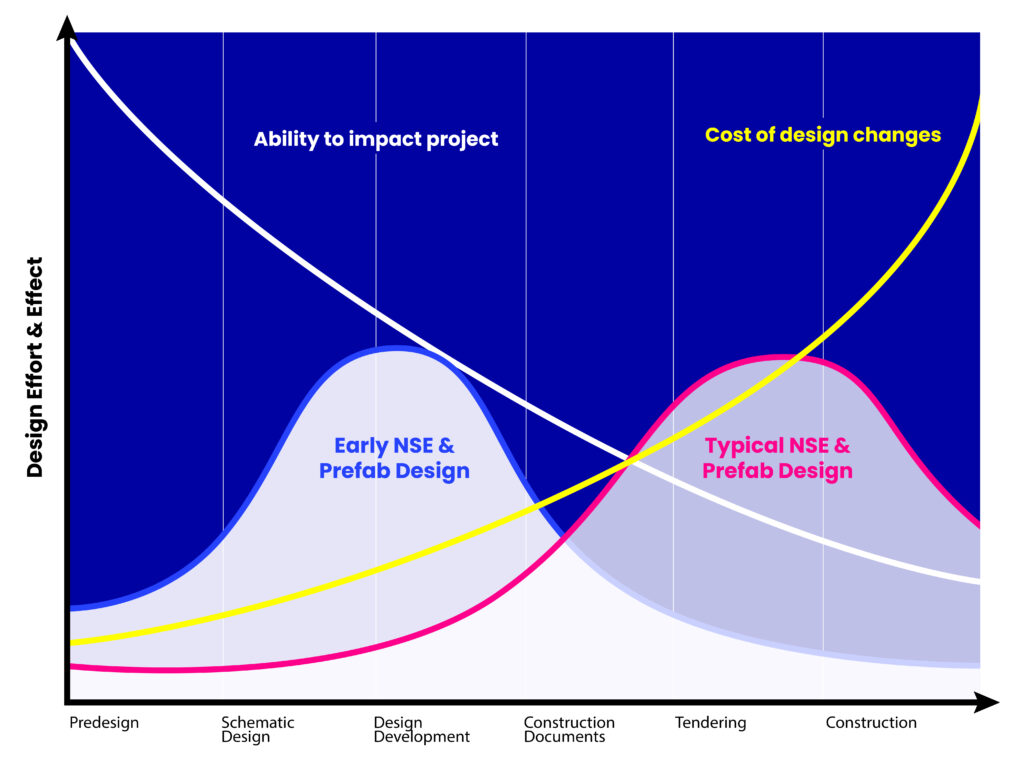
This holds true for the engineering of non-structural elements (NSEs: mechanical, electrical, hydraulic & fire systems, ceilings, and partitions). While consultants focus on the functional requirements of these systems during the initial phase, many aspects, such as how these services connect to the building, are resolved very late, often well into construction. A key reason for this is that these elements are typically handled by the contractors who build them. These contractors are often only brought into a project at the start of construction.
However, there are notable benefits to bringing increased consideration of NSE supports into earlier phases. First, non-structural components include many structural requirements, such as handling seismic, wind, gravity, and thermal actions. Common practice establishes services locations and reticulation pathways with little consideration of the associated structural performance objectives. This is risky, as the position of these systems has a considerable impact on their supports. Conversely, early consideration of structural implications can lead to gains in economy by utilising strategies that minimise or eliminate the need for additional framing.
Early consideration of NSE supports also greatly increases the feasibility of prefabrication and modularisation. While NSE prefabrication in Australia is increasing, it still largely occurs in isolated trades and preset pathways during the construction phase. Real gains are achieved when prefabrication methodologies inform construction sequencing and pathways, and when multi-service support systems are considered.
KUSCH engineers help head contractors integrate the structural engineering of services into a project at the planning phase, where the greatest gains are realised. This enables coordinated outcomes across all trades, shortening construction programs and improving site safety, compliance, and performance compared to the common trade-by-trade optimisation completed during construction.
To discuss how KUSCH can support your project across our capabilities of seismic, structural, prefabricated, and mechanical engineering, get in touch via: https://kusch.com.au/contact-us/