Beyond Static: Advancing the Seismic Design of Building Services
BackOur Director Martin Kusz recently travelled to Tokyo to present at the 2026 SPONSE Workshop – an international forum on the seismic performance of non-structural elements – sharing our latest research into the dynamic design of building services for earthquake loads.
Here’s a look at the problem we’re trying to solve, and how we’re applying structural dynamics to improve both the performance and economy of our seismic designs.
The Blind Spot in Traditional Seismic Design
In Australia, the NCC requires that all non-structural building elements are designed and installed for the seismic loads specified in AS 1170.4. To do this, engineers typically design restraints for ductwork, pipework and cable trays using equivalent static force-based methods and standardised brace spacings.
The limitation of this approach is that it doesn’t tell you how much these systems will actually displace during an earthquake. Differential movement is the primary driver of seismic damage – so designing without visibility of displacement means designing with a degree of uncertainty. For critical facilities that are required to remain operational following a seismic design event, that uncertainty is a problem.
Applying Structural Dynamics to Building Services
The principles of structural dynamics are well established in the design of buildings, but rarely applied to suspended building services. Accurately predicting the natural period and damping ratio of these systems is genuinely difficult. The dynamic properties of a electrical or communications tray loaded with bundles of cable, for example, are highly complex to calculate. This unpredictability has historically made it difficult to move beyond static approximations.
Measuring Rather Than Guessing
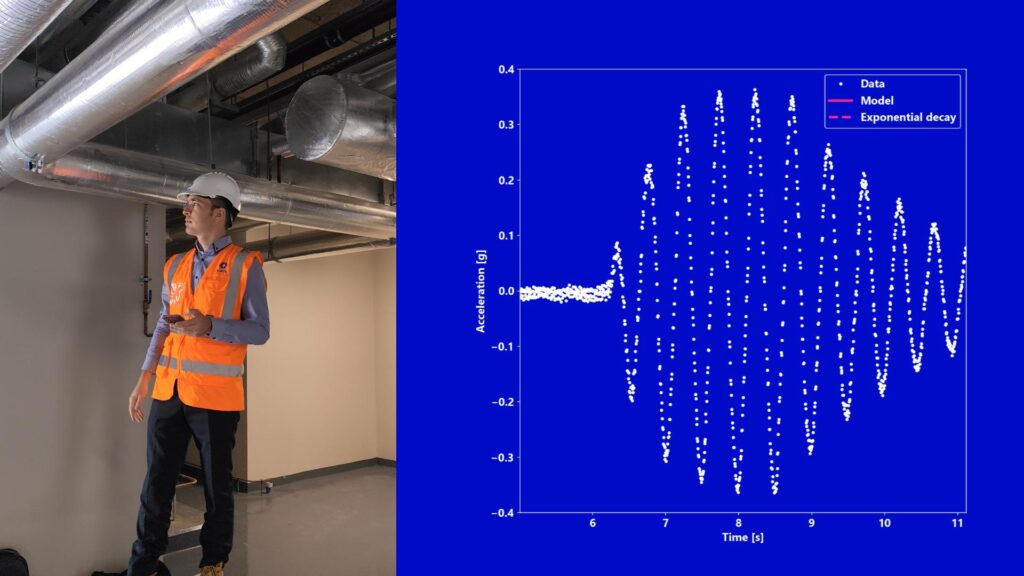
To address this, we developed an app that uses a Bluetooth accelerometer and smartphone to measure the dynamic properties of as-built services in the field. The process is straightforward:
- A simple push initiates oscillation in the suspended element
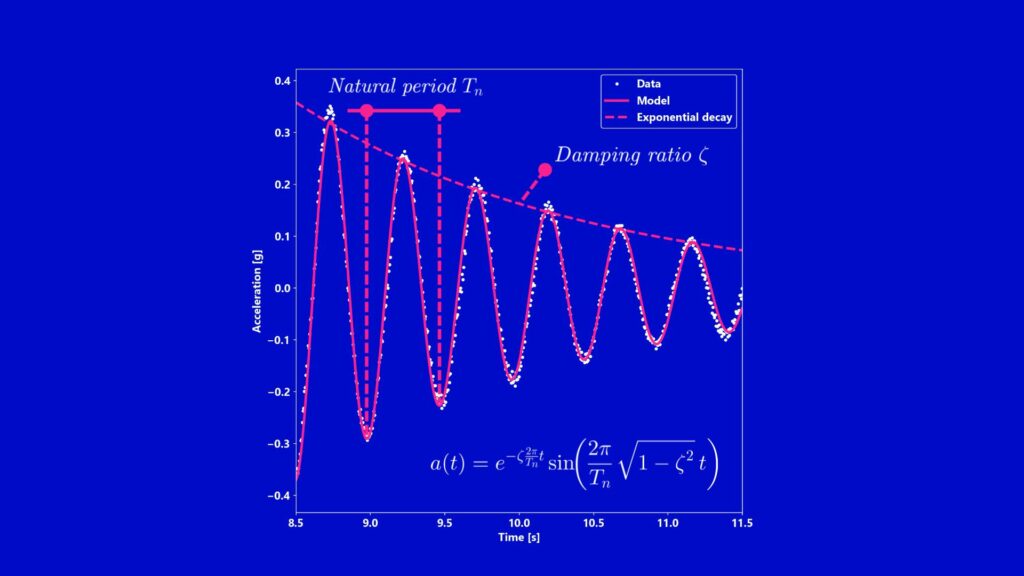
- The app measures the decay of that oscillation to determine the natural period and damping ratio
- Combined with floor response spectra, these measured dynamic properties allow us to determine how much a restrained or unrestrained suspended service will displace under seismic design loads.
What This Means in Practice
Testing services before and after restraint installation lets us confirm our designs are achieving the intended performance objectives. It also gives us visibility of potential performance issues related to penetrations at fire walls, and resonance and amplification effects that static methods frequently overlook.
Understanding actual system displacement also means we can develop more efficient seismic solutions in scenarios where low seismic demand is relatively low. Suspended services often possess a good degree of inherent isolation from the building structure and other elements. Where the dynamic response is well understood, designs can be developed around accommodating seismic movement rather than restraining it, similar to the design of base-isolation for buildings.
If you’re working on a project that requires seismic design for building services and would like to discuss how we might help, we’d love to talk.