Why More Engineering Time Means Lower Construction Costs
BackThere’s a trap project managers fall into on seismic compliance for non-structural elements under AS1170.4. They cut engineering hours upfront to save money.
Cheap or free engineering is expensive to build.
The MacLeamy curve explains why. Your ability to influence cost is highest at the start of a project, and the cost of changing anything climbs steeply once construction begins. Spend more engineering time during design and you shift the effort forward, resolving clashes and coordinating services on screen instead of on the slab.
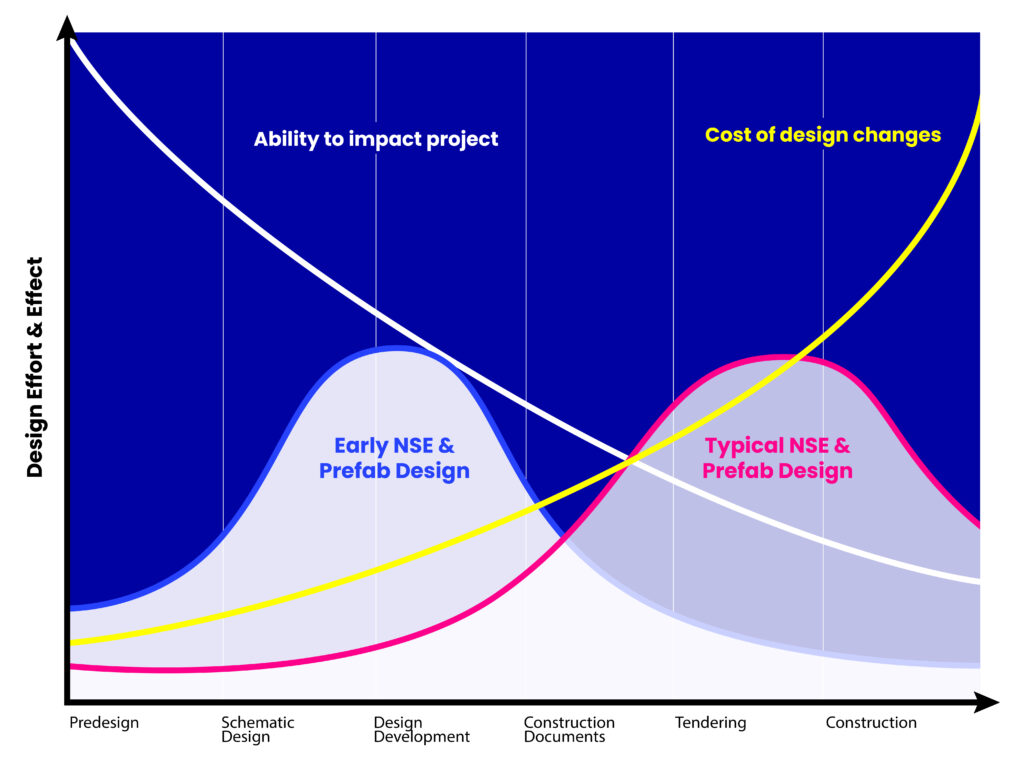
The Problem: The Brace Everything Trap
When an engineer is rushed or lacks specialist seismic expertise, they take the path of least resistance. Instead of calculating precise local demands, they apply a blanket, conservative assumption across the entire floor plate. They specify heavy, standardised bracing for every single run of pipe, duct, and cable tray.
The engineering fee looks low on paper. On site, it’s a mess.
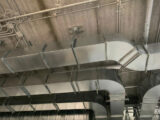
This low-budget or free-engineering design approach forces contractors to install hundreds of unnecessary braces. It crowds the ceiling plenum, creates massive coordination clashes with other services, and slows down the entire installation program. You pay twice: once for the wasted materials, and again for the hundreds of additional hours of on-site labour.
The KUSCH Approach: Dynamic Analysis
At KUSCH, we don’t like to guess, and we don’t like to use blanket assumptions. Instead, we like to use dynamic analysis.
Under Section 8 of AS1170.4, we are permitted to design using the established principles of structural dynamics. We calculate exactly how far the suspended services will move during an earthquake. Once we understand how the services actually behave, we can prove where bracing is genuinely needed and where it isn’t.
That upfront work routinely strips out hundreds of unnecessary braces. What’s left is a lean, coordinated install that’s quicker to procure and quicker to build.
Case Study: Frankston Hospital
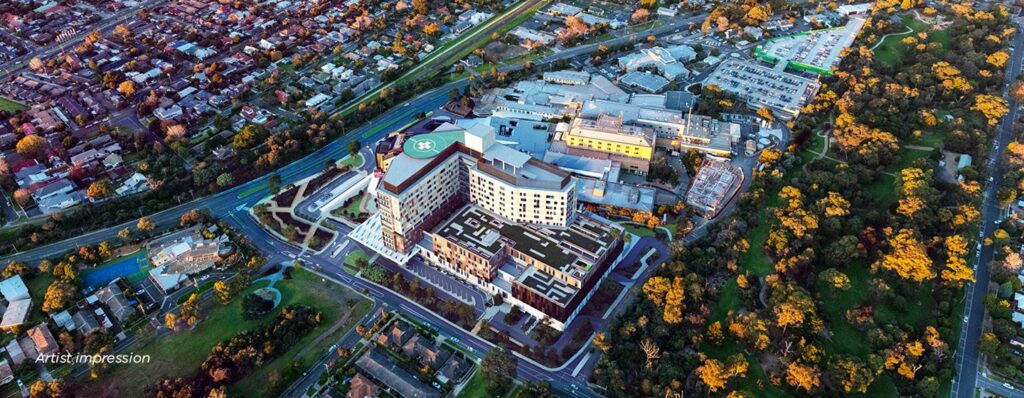
The Frankston Hospital Redevelopment is a $1.1 billion build, handed over in December 2025. As an Importance Level 4 facility, its services have to keep running after a 1:500-year earthquake. KUSCH helped multiple trades meet their requirements under AS1170.4, including AG Coombs on the mechanical package.
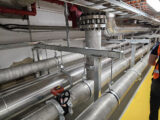
For AG Coombs’ seismic design, we used the base building engineer’s design data to calculate how far the pipework, ductwork, and suspended plant could move before any bracing was needed at all. From that we built a set of practical hanging heights, spacings, and details AG Coombs dropped straight into their design and coordination. Where services fell outside that envelope, we specified rigid bracing to limit the movement and hold the post-earthquake serviceability requirement.
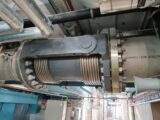
The plant room was prefabricated off-site in steel frames, with the seismic restraints for pumps, equipment, and modules built in.
The Bottom Line
For site managers, builders, and directors, this comes down to control. Engineering time upfront protects your program and your budget. Bring in specialists who design for buildability from day one and you get the certainty to deliver on time and on budget.